
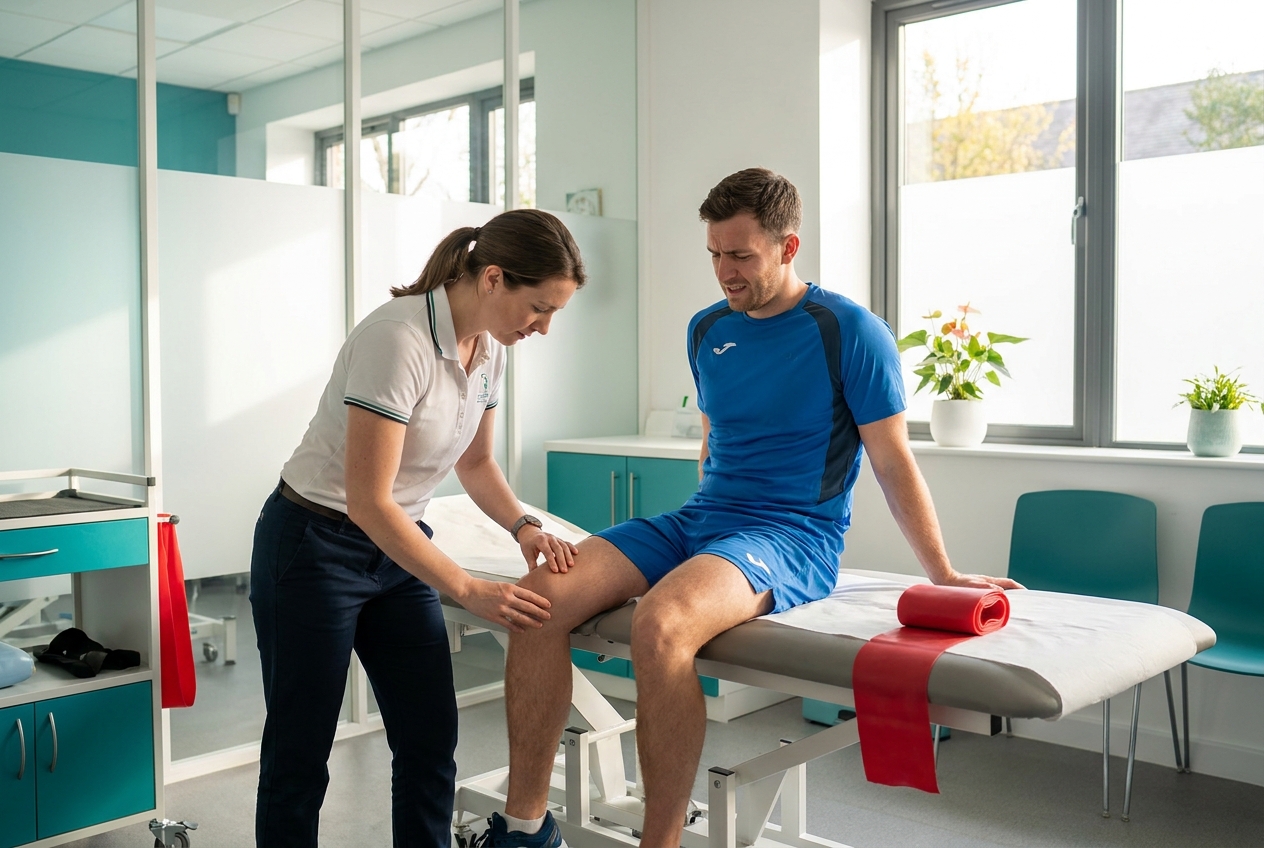
Featured image: illustration of a knee assessment, not a documented patient case.
Wondering whether dry needling could help your knee pain before your next padel match, gym session or working day? The useful first question is not where to put a needle, but what is causing the pain. Dry needling targets muscle tissue; knee pain can involve several different structures and conditions. It should not be booked as an automatic treatment for every sore knee.
If you are considering dry needling for knee pain in Dubai, start with an assessment and ask how the proposed treatment fits your diagnosis. One important distinction: NICE guidance specifically advises against dry needling for osteoarthritis. Here is how to approach the decision without guessing what your knee needs.
Why the cause of knee pain matters
A knee that hurts after a twist is not necessarily dealing with the same problem as a knee that has gradually become stiff. The NHS lists sprains, tendon problems, ligament or meniscus injuries and osteoarthritis among possible causes. Symptoms can overlap, so an online description cannot establish your diagnosis.
Before your appointment, note when the pain began, whether there was an injury, where you feel it and which activities bring it on. Mention swelling, locking, giving way and difficulty straightening the knee. These details help a clinician decide what needs examining, rather than starting with your preferred treatment.
What dry needling does—and what to ask about it
Dry needling involves inserting fine needles into muscle tissue associated with sensitive areas often called trigger points. No medication is injected. Cleveland Clinic describes it as a technique usually used within a wider treatment plan, rather than an isolated procedure.
That description is not proof that it is suitable for your particular knee problem. If a clinician proposes needling muscles around your knee, ask which finding from your assessment supports that choice and what change they expect to monitor. Avoid choosing treatment simply because a muscle feels tight or because someone else found needling helpful.
PhysioFit offers dry needling in Dubai. An assessment is the place to discuss whether it belongs in your care, what alternatives exist and whether you would prefer a non-needle approach.
If you have knee osteoarthritis, exercise takes priority
For osteoarthritis, NICE guideline NG226 states: “Do not offer acupuncture or dry needling to manage osteoarthritis.” This is UK clinical guidance, not a statement of UAE law, and it applies specifically to osteoarthritis rather than every cause of knee pain.
The same guideline identifies tailored therapeutic exercise, information and support, and weight management where appropriate as core treatments. Exercise can include local muscle strengthening and general aerobic fitness. NICE notes that discomfort may initially increase, but consistent, appropriately tailored exercise can improve pain and function over time.
If you have been told you have osteoarthritis, ask for an exercise plan matched to your current ability and a clear review point. Discuss difficulties with the clinician rather than replacing the plan with repeated needling appointments. Severe new pain or a hot, swollen knee needs assessment, not an assumption that it is an ordinary exercise response.
Four practical questions before agreeing to treatment
1. What are we treating?
Ask for a plain-language explanation of the likely problem and any uncertainty. “Knee pain” describes a symptom; it does not explain why a particular intervention has been selected.
2. What will we measure?
Choose a meaningful activity to discuss, such as using stairs or getting up from a chair. Ask how progress will be reviewed and what would prompt a change of plan. A promised number of sessions is not a substitute for reassessment.
3. What are the risks and alternatives?
Dry needling can cause soreness, bruising, fainting and infection. Tell the clinician about blood-thinning medication, pregnancy, immune-system problems, recent surgery and fear of needles. These can affect suitability and precautions; do not stop prescribed medication yourself. Ask about non-invasive alternatives and make sure you understand the procedure before consenting.
4. What happens outside the appointment?
Ask which activities to modify, which exercises to practise and what symptoms should trigger a call. Bring any surgical instructions or existing rehabilitation plan so advice can be coordinated. Do not use a generic online exercise list as clearance to return to sport after surgery or injury.
When to seek urgent medical advice instead
Seek urgent medical assessment if your knee is very painful, you cannot move it or bear weight, it is badly swollen or has changed shape, or it locks or gives way. Fever or shivering with a hot, red knee can indicate infection. These NHS warning signs warrant prompt local medical care in Dubai, not waiting for a routine needling appointment.
Choose an assessment, not a predetermined procedure
PhysioFit’s knee injury physiotherapy service includes assessment and rehabilitation. If knee symptoms are limiting daily life or exercise, you can contact the PhysioFit clinic in Business Bay to discuss an appointment. Bring your questions about dry needling, but keep the goal broader: understanding the problem and choosing an appropriate plan. This guide provides general information and cannot replace an individual assessment.