
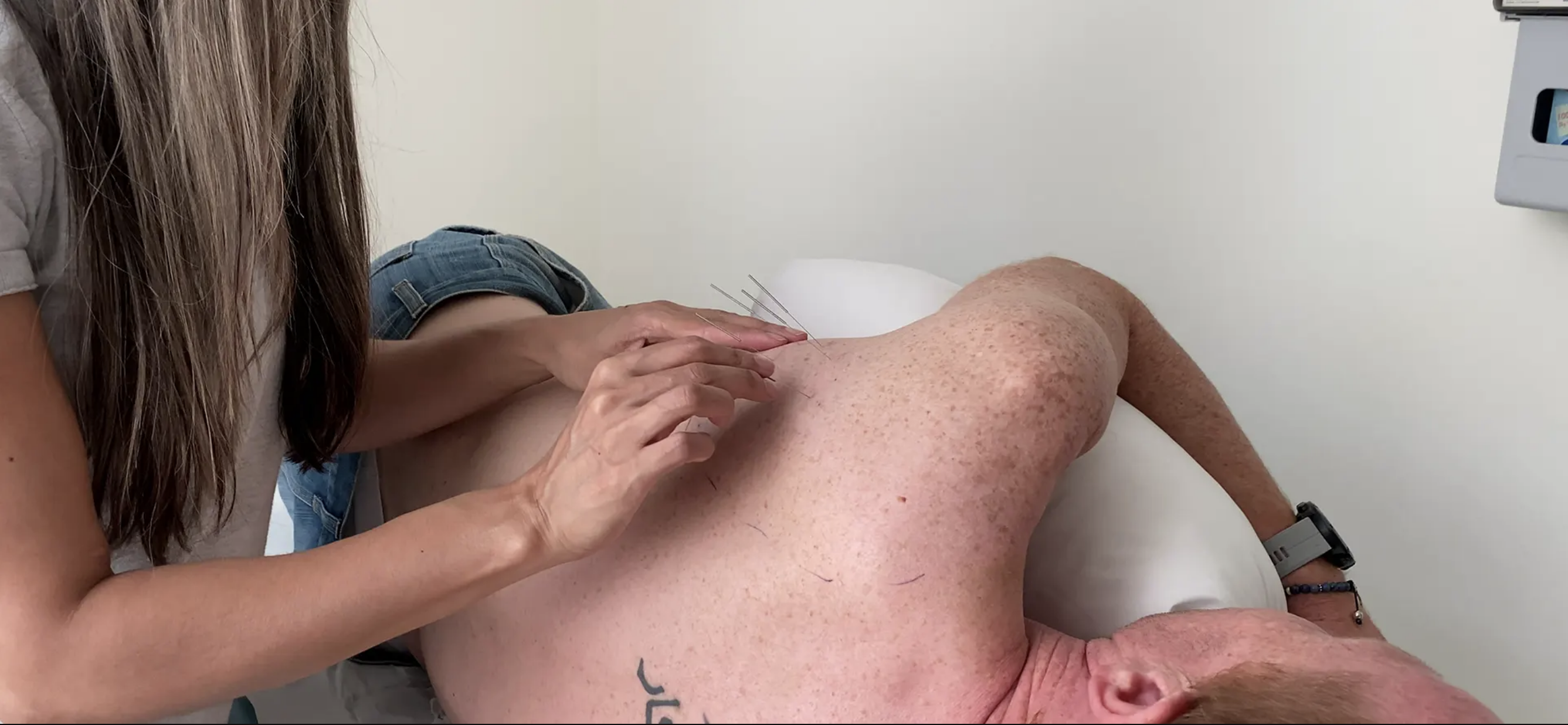
What Is Dry Needling?
Dry needling is a modern, evidence-based treatment used by physiotherapists to release muscle tension and relieve pain. It involves inserting very thin, sterile needles — the same kind used in acupuncture — directly into myofascial trigger points: the tight, irritable “knots” that form in overworked or injured muscle.
Unlike acupuncture, which is rooted in traditional Chinese medicine and focuses on energy meridians, dry needling is based on Western anatomy and neurophysiology. The goal is simple: deactivate the trigger point, restore normal muscle function, and reduce pain.
At PhysioFit, our dry needling in Dubai is performed by licensed physiotherapists as part of a broader rehabilitation plan — never as a standalone quick fix.
How Does Dry Needling Work?
When a muscle is injured, overloaded or held in one position for too long (hello, desk workers), small areas within it can become contracted and hypersensitive. These are trigger points. They restrict blood flow, refer pain to other areas, and stop the muscle from working properly.
Inserting a needle into the trigger point does three things:
- Releases the knot: The needle stimulates a local “twitch response” — a brief involuntary contraction — after which the muscle fibres relax and lengthen.
- Improves blood flow: Fresh, oxygenated blood reaches the area, flushing out inflammatory chemicals and supporting healing.
- Calms the nervous system: Needling modulates pain signals both locally and in the spinal cord, reducing sensitivity in the surrounding tissue.
What Does Dry Needling Actually Feel Like?
This is the question every first-timer asks. The honest answer: much less dramatic than you expect.
The needles are hair-thin — far finer than an injection needle — and most people feel little more than a light scratch or nothing at all on insertion. When the needle reaches the trigger point, you may feel a deep ache, a brief cramp, or that characteristic twitch. It can be momentarily uncomfortable, but it lasts only a second or two, and most patients describe it as a “good pain” because they can feel the muscle letting go.
Afterwards, it’s normal to feel mild soreness in the treated area for 24–48 hours — similar to post-workout muscle ache. A bit of gentle movement and hydration usually settles it quickly.
Is Dry Needling Safe?
Yes — when performed by a properly trained, licensed physiotherapist. At PhysioFit, dry needling is carried out under strict hygiene protocols with single-use, sterile needles, and only after a full assessment to confirm it’s appropriate for you.
Side effects are minor and short-lived: temporary soreness, occasional small bruising, or brief light-headedness in sensitive patients. Serious complications are extremely rare in professional hands.
There are a few situations where we’d modify or avoid treatment — pregnancy, bleeding disorders, needle phobia, or infection near the treatment site — which is exactly why the assessment comes first.
What Conditions Does Dry Needling Help With?
Dry needling is one tool within physiotherapy, and it works best for muscle-driven pain and movement problems. We commonly use it for:
- Neck and shoulder tension from long hours at a desk or laptop
- Lower back pain with tight, guarding spinal muscles
- Sports injuries — calf, hamstring and hip tightness in runners, gym-goers and padel players
- Tension headaches driven by trigger points in the neck and upper shoulders
- Knee pain where tight quads or ITB tension are contributing
- Jaw and facial muscle tension, often alongside TMJ treatment
Dry Needling vs Massage: Which Do You Need?
Both release tight muscle, but they work at different depths. Massage and sports massage in Dubai are excellent for general muscle tension, recovery and circulation. Dry needling reaches deep, specific trigger points that hands simply can’t access with the same precision.
In practice, we often combine them: needling to release the stubborn knots, hands-on work and movement to retrain the muscle afterwards. Your physiotherapist will recommend the right mix based on your assessment.
What Happens in a Session at PhysioFit?
Your first visit starts with a proper assessment — not needles. We look at your movement, posture, training load and history to find out why the muscle became a problem in the first place. Treating a trigger point without addressing its cause just means it comes back.
If dry needling is appropriate, the needling itself takes only a few minutes per muscle group. We usually follow it with manual therapy, stretching, or specific exercises to lock in the release and restore normal movement. Most people notice a difference within 1–3 sessions, though long-standing issues take a little longer.
Because it’s integrated into sports physiotherapy in Dubai at our physiotherapy clinic in Business Bay, dry needling here is never a one-off gimmick — it’s part of a plan to get you moving properly again.
The Bottom Line
Dry needling is a safe, effective, minimally uncomfortable treatment when performed by trained physiotherapists — and for the right kind of muscle pain, it can be remarkably fast. The key is professional assessment first, and combining it with rehabilitation so the results last.
If muscle tension, stubborn knots or recurring tightness are holding you back, book an assessment at PhysioFit Sports & Rehab Clinic in Business Bay. We’ll tell you honestly whether dry needling — or another approach — is the right fit for you.