
Padel and the Achilles tendon: a Dubai love story (with a twist)
If you play padel in Dubai, you already know the drill: last-minute WhatsApp games after work, back-to-back matches at the weekend, and maybe a league night squeezed in somewhere between. Padel is social, addictive and deceptively demanding — and one structure takes the brunt of it more than almost any other: the Achilles tendon.
Achilles pain is one of the most common issues we see in racket-sport players at PhysioFit, and the good news is that in most cases it responds extremely well to the right rehabilitation — no injections, no surgery, and usually no need to stop playing entirely. The key is understanding what the tendon is telling you, and loading it correctly rather than simply resting it.
Why padel players are so prone to Achilles problems
The Achilles tendon connects your calf muscles to your heel bone and acts like a spring, storing and releasing energy every time you push off. Padel is a perfect storm for it:
- Constant changes of direction. Short, sharp lateral movements and sudden sprints to the net load the tendon repeatedly and unpredictably.
- A lot of time on the forefoot. The low, ready position used in padel keeps the calf under near-constant tension.
- Playing frequency jumps quickly. Many players go from one casual game a week to three or four sessions in the space of a month — a spike in load the tendon hasn’t been conditioned for.
- Hard courts and worn shoes. Artificial grass over concrete with sand is unforgiving, and shoes past their best reduce the cushioning the tendon relies on.
Add Dubai’s heat, which often means players warm up less thoroughly, and you have a recipe for a grumpy tendon.
Early warning signs you should not ignore
Achilles problems rarely appear overnight. They usually whisper before they shout. Look out for:
- Stiffness or pain at the back of the heel first thing in the morning that eases as you move
- A tender, sometimes slightly thickened area a few centimetres above the heel bone
- Discomfort at the start of a match that warms away, then returns the next day
- Pain when hopping, sprinting or pushing off aggressively
If you recognise the morning-stiffness pattern, your tendon is already asking for help. Acting at this stage usually means a much shorter and simpler recovery.
Why complete rest is rarely the answer
It’s natural to think “it hurts, so I’ll stop”. But tendons don’t heal like skin or muscle — they adapt to load, and complete rest actually makes them weaker and less tolerant when you return. Modern tendon rehabilitation is built on a simple principle: reduce the aggravating load, then rebuild capacity progressively.
That might mean temporarily dropping from four sessions a week to two, avoiding tournaments for a few weeks, and replacing some court time with structured strength work — not giving up the sport you enjoy.
What a structured rehab plan looks like
While every plan is individual, Achilles tendinopathy rehab typically progresses through:
- Isometric holds (static calf contractions) to settle pain early on
- Heavy, slow calf raises — both straight-knee and bent-knee — to rebuild tendon capacity
- Eccentric and plyometric progressions (controlled lowering, then hopping and jumping) to restore the spring-like function padel demands
- A graded return to court, guided by how the tendon responds the following day, not just during the session
A simple rule of thumb we use: pain during exercise that stays mild (roughly 3–4 out of 10) and settles within 24 hours is usually acceptable. Pain that lingers or worsens into the next morning means the load needs adjusting.
How physiotherapy speeds up your return to the court
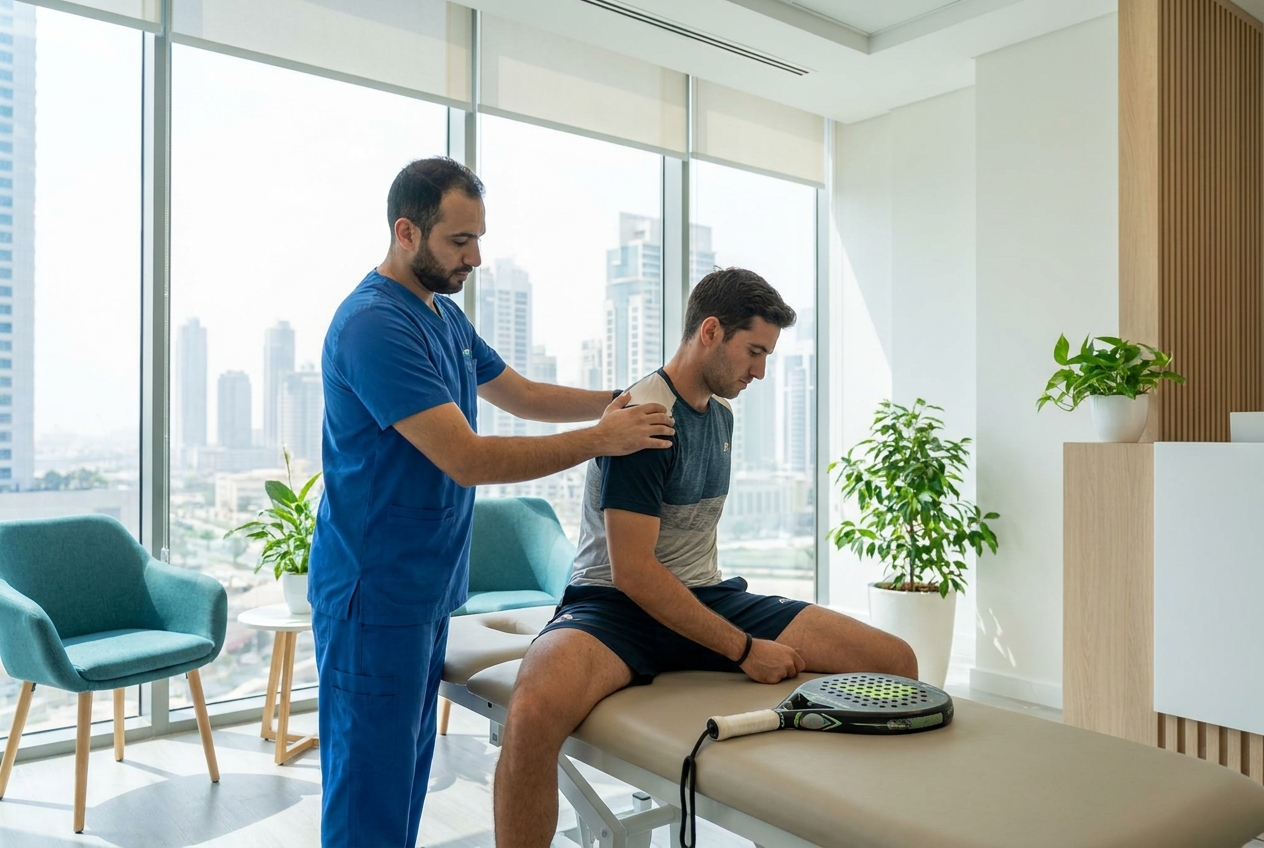
Working with a physiotherapist takes the guesswork out of this. At PhysioFit, an Achilles assessment for a padel player typically includes:
- A detailed history of your playing load, footwear and training habits
- Strength and capacity testing of the calf and surrounding muscles
- Screening for contributing factors — ankle stiffness, hip weakness, movement patterns
- A personalised loading programme with clear progressions
Hands-on treatment can help settle symptoms alongside exercise. Many of our padel players benefit from dry needling to release tight, overactive calf muscles, as well as sports massage and, where appropriate, shockwave or other modalities. For players whose Achilles pain is part of a broader picture, our padel injury rehabilitation and sports physiotherapy services address the whole kinetic chain, not just the sore spot.
Most players with reactive tendinopathy see meaningful improvement within 6–12 weeks of consistent rehab — often while continuing to play in a modified way.
Simple habits that protect your Achilles on court
- Warm up properly: five minutes of dynamic movement plus progressive calf raises and light hops before your first point
- Build up gradually: increase playing frequency by no more than one session a week
- Strengthen twice a week: calf raise variations year-round, not just when something hurts
- Check your shoes: replace padel shoes regularly; dead cushioning loads the tendon
- Respect the morning stiffness: it’s your tendon’s report card — if it’s getting worse, get assessed
When to book an assessment
If your Achilles has been niggling for more than two weeks, if the morning stiffness is becoming a daily ritual, or if pain is forcing you to change the way you move on court, it’s time to have it looked at properly. Early treatment is almost always faster and simpler than rehabbing a tendon that has been struggling for months.
At PhysioFit Sports & Rehab Clinic in Dubai, our physiotherapists work with padel players every week — from social players to competitive league athletes — and we’ll build a plan that keeps you on court wherever safely possible. Book an appointment today and let’s get you moving freely again.